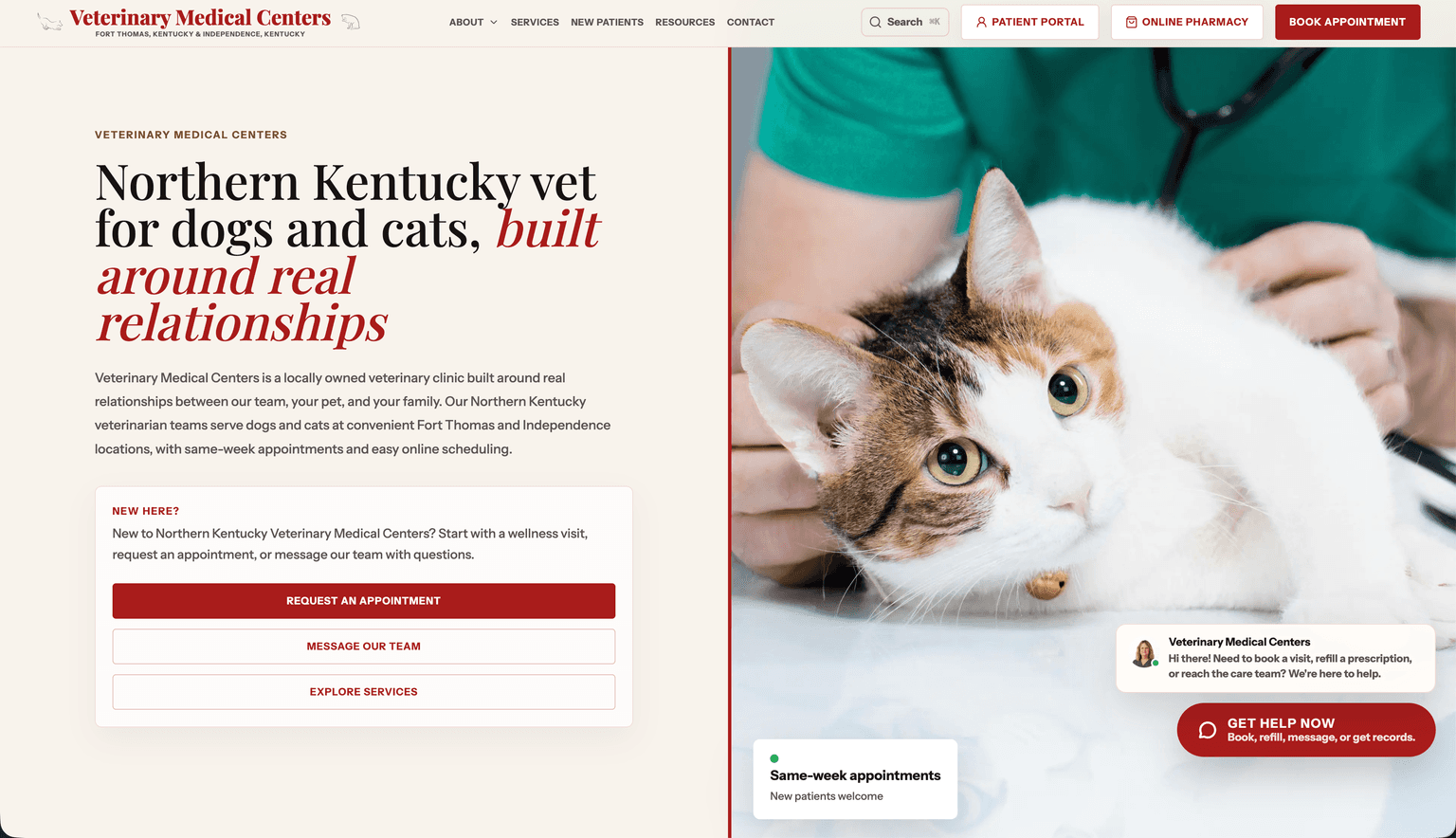
Trust before conversion
Pet owners need to feel the clinic is credible, local, and caring before they take action.
 Veterinary Care · Northern Kentucky
Veterinary Product Platform
I designed and developed a measurable digital care platform for a multi-location veterinary practice that improved local discoverability, patient trust, appointment pathways, content operations, and employer brand perception.
Veterinary Medical Center is an independently owned practice serving Fort Thomas, Independence, and surrounding Northern Kentucky communities. Pet owners often search under stress, urgency, or uncertainty.
The platform needed to support the business beyond patient acquisition: local discoverability, appointment conversion, existing-client self-service, staff content operations, recruiting credibility, and long-term service/location growth. This was not a brochure refresh. It was a business-critical digital platform.
The strategy connected patient needs, operational workflows, search behavior, and employer brand credibility.
Pet owners need to feel the clinic is credible, local, and caring before they take action.
New clients and existing clients have different jobs and should not be forced through the same path.
Location pages, city relevance, travel context, and service-local pairing are part of the UX, not just SEO.
Pages explain care in plain language, answer common questions, and guide users toward the right next step.
Clinic staff need structured ways to maintain high-change information without inconsistent one-off updates.
A modern, credible site can influence prospective veterinarians and staff, not only pet owners.
Clinic goals, operational pain points, recruiting challenges, and content maintenance needs.
Separate acquisition, self-service, recruiting, and operations requirements instead of treating the site as marketing only.
Local competitors, high-intent search behavior, city/location opportunities, and credibility patterns.
Build service and location pages around Northern Kentucky search behavior and trust signals.
New pet owner, urgent-concern owner, and existing-client tasks across discovery, evaluation, action, and ongoing care.
Split new-patient and existing-client pathways so repeat users are not forced through acquisition content.
Services, resources, locations, FAQs, portal links, pharmacy links, team content, and update ownership.
Create structured content models and reusable templates for high-change information.
Headings, labels, contrast, keyboard paths, focus states, forms, cognitive load, and link clarity.
Design navigation, forms, labels, and CTAs for stressed mobile users and assistive tech users.
Routing, templates, CMS/content model, analytics, metadata, performance, and maintainability.
Modernize architecture around reusable templates, SEO metadata, analytics, and content operations.
“I need a trustworthy vet nearby and want to know how to start.”
Start care confidently.
New-patient flow, location context, owner-led care story, and first-visit guidance.
“Something may be wrong and I need clarity quickly.”
Get direct next steps with low cognitive load.
Direct CTAs, scannable service pages, clear contact options, and urgent-friendly copy.
“I already know the clinic. I just need the portal, pharmacy, forms, or resources.”
Complete routine tasks fast.
Existing-patient pathway, portal/pharmacy labels, contact links, and resource connections.
“We need accurate content online without relying on developers for every update.”
Maintain content safely.
CMS content models, validated fields, reusable templates, and resource publishing structure.
“I’m evaluating whether this practice feels professional and aligned with how I want to practice.”
Assess credibility, culture, and practice quality.
Professional site quality, independent care positioning, staff credibility, and service depth.
The IA reorganized the platform around intent: start care, continue care, learn about services, choose a location, and build trust.
Homepage → About → Services → Locations → Contact → Resources → External links
Homepage → Start as New Patient → Existing Patients → Services → Locations → Nearby Cities → Resources → About VMC → Contact
New pet owners needed clear expectations and a confident first step.
Make “Start as a New Patient” the primary action rather than a generic contact CTA.
New-patient flow, expectation copy, location context, and appointment request pathway.
Clearer conversion path and reduced hesitation.
Existing clients do not want marketing content when completing routine tasks.
Separate existing-patient needs from acquisition content.
Portal, pharmacy, contact/live chat, resources, and forms surfaced as predictable pathways.
Reduced friction and potential staff burden.
Pet owners search by location, service, symptom, and urgency.
Build service and location pages around high-intent Northern Kentucky search behavior.
Fort Thomas, Independence, nearby city, and service-specific content structure.
Traffic grew from under 5-10 visits/day to 50+ consistent daily visits; multiple local terms reached #1 positions.
Pet owners choose care under uncertainty and need quick confidence.
Lead with independent, locally led, practical care positioning.
Owner/provider story, location clarity, staff credibility, service depth, reviews, and warm visual identity.
Improved patient confidence and employer brand credibility.
The practice had been recruiting for a veterinarian for roughly two years.
Make the website communicate professionalism, culture, quality of care, and growth.
Modernized platform, stronger brand presentation, clearer staff/provider credibility, and local presence.
Within roughly one month of launch, VMC secured a veterinarian; the candidate cited the website as a primary reason she reached out.
Clinic information changes often: hours, services, staff, resources, portal links, pharmacy links, and announcements.
Treat content operations as a product requirement.
Structured content models, reusable templates, validated fields, and resource publishing workflows.
Reduced dependency on one-off development and made the platform easier to maintain.
Pet owners may be stressed, mobile, or urgently seeking information.
Design for clarity, keyboard access, readable content, descriptive CTAs, and predictable navigation.
Improved hierarchy, persistent labels, focus states, descriptive links, clear errors, and scannable service pages.
More inclusive and usable experience for stressed users.
The business needed to understand whether the new experience improved visibility and conversion.
Instrument the platform for traffic, SEO, conversion, and content performance.
Analytics, Search Console, conversion event plan, form/call/location tracking recommendations.
Enabled the traffic growth story and created a framework for ongoing optimization.
The biggest outcome was not a modern-looking veterinary website. It was a care platform that became easier to find, trust, contact, maintain, and use as a recruiting signal.
This project reinforced that local healthcare platforms can create measurable business impact when design decisions connect patient needs, operational workflows, search behavior, and brand credibility.
VMC’s website became both a patient acquisition platform and an employer brand asset. Treating local SEO as UX strategy, separating user intent paths, building trust before conversion, and designing content operations as product infrastructure made the work measurable and maintainable.
The site is live at nky.vet for pet owners across Fort Thomas, Independence, and Northern Kentucky.