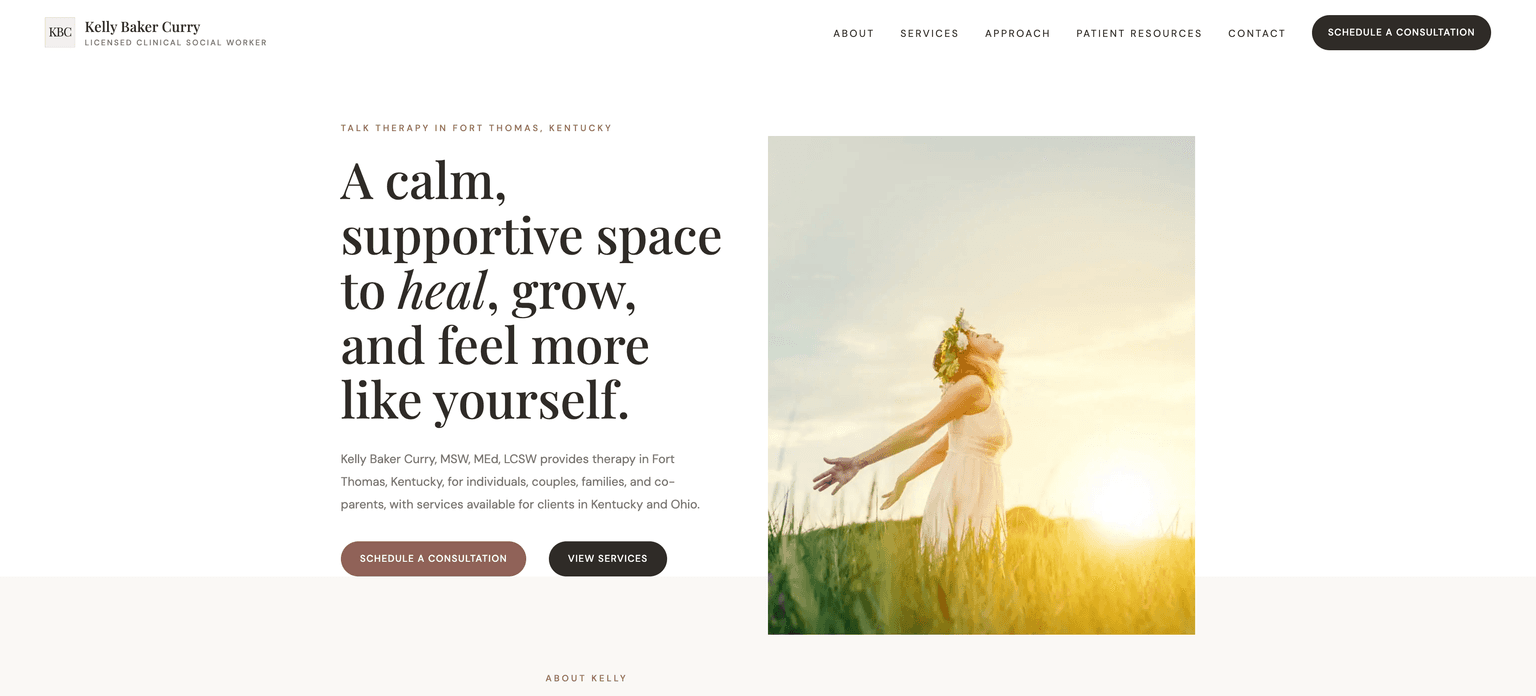
Calm before conversion
The experience reduces pressure and makes therapy feel approachable.
Therapy Product Design
I designed and developed a focused therapy care discovery platform that helps prospective clients understand services, evaluate fit, review logistics, and request care through a structured, privacy-conscious consultation flow.
Starting therapy is emotionally sensitive. Users may arrive anxious, overwhelmed, uncertain, embarrassed, or cautious. The product needed to build trust before asking for action.
The goal was not aggressive conversion. The goal was to make the first step feel clear, respectful, and safe for individual therapy seekers, couples, families, co-parenting clients, and logistics-first clients comparing fees, format, insurance, and location.
The experience reduces pressure and makes therapy feel approachable.
Users understand individual, couples, family, and co-parenting therapy without dense terminology.
Fees, insurance notes, location, appointment format, and process expectations are easy to find.
The implementation stays fast, focused, and maintainable instead of overbuilt.
“I know I need support, but I’m not sure how to start.”
Privacy, reassurance, service clarity, and a low-pressure consultation path.
Service cards, calm hero copy, privacy guidance, and clear first-step CTAs.
“We need help communicating, but I want to understand the process first.”
Relationship-focused language, trust, private-pay clarity, and clear next steps.
Couples pathway, payment acknowledgement, and structured additional-contact logic.
“Our family needs help navigating conflict or change.”
Participation clarity, scheduling coordination, reassurance, and practical next steps.
Family pathway, multi-person coordination fields, and expectation-setting copy.
“We need structure, boundaries, and communication support.”
Neutral language, private-pay acknowledgement, coordination, and clear expectations.
Co-parenting pathway, neutral UX writing, conditional contact logic, and private-pay flow.
“Before I reach out, I need to know fees, insurance, format, and location.”
Fees, insurance, format, Fort Thomas location, Kentucky/Ohio availability, and response expectations.
Fee visibility, FAQ content, local SEO copy, and review step before submission.
Local SEO metadata, Fort Thomas positioning, and clear hero message.
Provider intro, service cards, and therapy approach section.
Scannable services, fee section, FAQs, office/location content, and resources.
Modal intake, progress stepper, conditional logic, payment logic, and privacy guidance.
Email workflow, validation, Turnstile spam protection, and clearer user expectations.
People considering therapy need clarity without clinical overload.
Present four scannable pathways for individual, couples, family, and co-parenting therapy.
Service cards and common-reason language help users self-identify.
Clearer understanding of fit before reaching out.
Users may overshare sensitive information in a general inquiry form.
Use a structured six-step flow with explicit privacy guidance.
Warn users not to include diagnoses, medications, insurance IDs, SSNs, urgent safety concerns, or detailed medical history.
Reduces inappropriate sensitive submissions while keeping the first step approachable.
Different therapy pathways have different payment/insurance expectations.
Make payment expectations part of the flow.
Individual therapy supports insurance/self-pay selection; couples/family/co-parenting include private-pay acknowledgement.
Improves follow-up readiness and reduces confusion.
Couples, family, co-parenting, and guardian situations often involve more than one contact.
Use conditional additional-contact sections.
Only show extra contact logic when relevant to the selected service type.
Keeps simple inquiries simple while supporting complex coordination.
The practice needed local visibility without keyword-stuffed mental health copy.
Create Fort Thomas, Kentucky positioning with Kentucky/Ohio availability and structured metadata.
Metadata, OpenGraph, FAQ schema, breadcrumb schema, and service-specific content support discovery.
Stronger local search foundation.
A small practice needed maintainability, speed, and reliability without overbuilt admin complexity.
Build a lean Next.js/React/TypeScript platform with CSS Modules, email delivery, and spam protection.
Nodemailer inquiry workflow, Cloudflare Turnstile, responsive components, and structured data.
Polished production site without unnecessary platform overhead.
Reviewed therapy practice needs, user uncertainty, service types, fee/payment questions, local SEO, and intake complexity.
Mapped service pathways, intake requirements, privacy constraints, payment rules, and content hierarchy.
Created calm visual direction, service cards, CTA hierarchy, modal flow, form steps, and responsive layouts.
Implemented Next.js, React, TypeScript, CSS Modules, reusable components, metadata, structured data, conditional form logic, and email submission.
Added Turnstile spam protection, privacy-conscious form copy, and clear boundaries around sensitive information.
Shipped a focused therapy platform with service discovery, local SEO, responsive design, and structured consultation requests.
Better structure, clearer expectations, and more useful inquiry data.
Reduces confusion and improves follow-up readiness.
Better scanning and self-identification.
Better maintainability for a smaller practice.
Helps prevent inappropriate sensitive information in a general form.
This project reinforced that smaller products still require strong product judgment. The right solution was not a heavy platform or complex CMS; it was a focused, emotionally considerate experience that reduced uncertainty for prospective clients while giving the practice a reliable, maintainable digital foundation.
The strongest decisions balanced conversion with care and privacy: a structured intake flow, clear service pathways, visible logistics, and lightweight production code that matched the real scope of the practice.
Designed to reduce uncertainty for therapy clients while giving the practice a polished, maintainable Next.js foundation.